The Hofmeister Kink: A Lasting BMW Design Detail
Sometimes the smallest things can make the biggest differences. They can carry powerful associations that aren't immediately obvious. Some good examples are:
The idea that a detail can make a big difference has always been fascinating to me. I've also always been really fascinated by cars and automotive design. So a few months ago when I saw that Jalopnik named "The Hofmeister Kink" the number one design element of all time I was interested. I had never heard of it before and I couldn't see how it could make much of a difference at all in the overall design of a car.
Below is my attempt to figure out what this detail is and how it can make a difference.
What is the Hofmeister Kink?
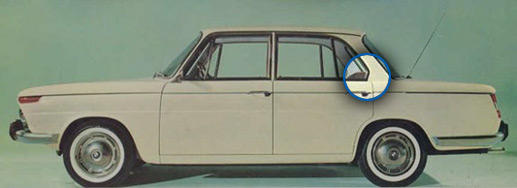
The Hofmeister kink is a small design feature of BMWs. It is the name for the small cutout of the rear side windows on the C-pillar of the car. Rather than having the rear side window extend all the way down as might be expected, it angles back toward the front of the car. It is named after the legendary Director of Design at BMW, Wilhelm Hofmeister. It first appeared on the 1961 BMW 1500. You can see this on the 1500 in the image below. (Circled in blue)
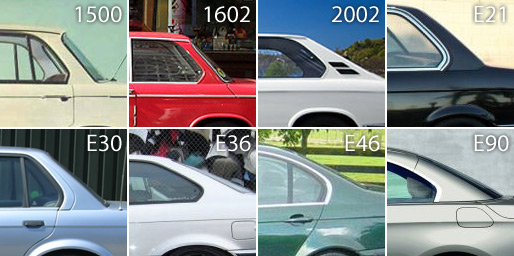
The Hofmeister kink has become a signature design element of all BMWs. BMW claims that it "subtly highlights" that the cars are rear-wheel drive. Since it first appeared, the kink has appeared on every BMW manufactured. Below is the C-Pillar of all of the BMW "Compact Exec" type cars since the 1500. (The modern model is the 3-Series)
During that time BMW has become synonomous with quality; the 3-Series is a legend and has been named to the Car and Driver Ten Best list every year since 1992. As expected, the Hofmeister kink is now appearing on all kinds of cars. My hypothesis was that it would appear most on cars that were meant to seem luxurious, or high-end. Naturally, it wouldn't appear on a Mercedes, being rivals with BMW and I would be surprised to see it on any car or make with a strong design history.
How Manufacturers Use the Kink to Distinguish Marques
Auto manufacturers typically have more than one marque of car so that they can target both luxury car buyers as well as more value-minded consumers. A manufacturer often competes with itself, offering similar cars across marques that differ primarily in levels of luxury. Some examples of differet lines from different manufacturers are:
- Ford - Mercury/Lincoln
- Chevy - Oldsmobile - Buick - Cadillac
- Honda - Acura
- Toyota - Lexus
- Nissan - Infinity
I've noticed that many of these brands has been the use of the Hofmeister Kink to distinguish between similar models of different marques. Below are some examples:
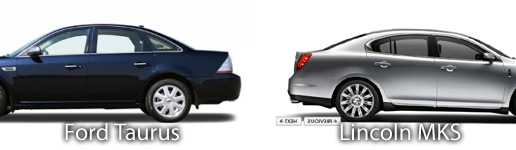
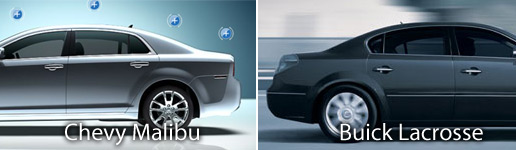
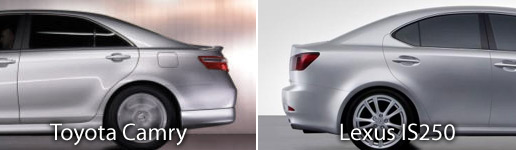
There are many other examples (and a couple counter-examples) but the trend is clear, particularly when looking at cars made after the mid 1990s. Some notable exceptions are:
- Mercedes - As mentioned above they are unlikey to use a signature design feature from BMW.
- Cadillac - They currently have a very strong design language of their own.
- Honda/Acura - The Accord and its Acura equivalents all have the Kink
- Nissan/Infiniti - All of their cars have the kink (not true a decade ago)
Korean Manufacturers Try to Move Upmarket
The Korean auto manufacturers, Hyundai and Kia are seemingly trying to duplicate the path to success that Honda used. Start with cheap economy cars, earn a reputation for quality and move upmarket into more expensive luxury models. In the last couple of years, both Hyundai and Kia have introduced more luxurious sedans and SUVs. While the Kia Amanti has clearly taken heavy design inspiration from Mercedes (no kink!), its Optima sedan is more in line with other manufacturers. Below are two examples:
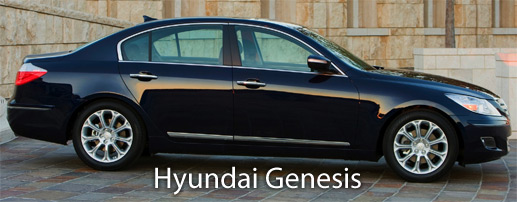
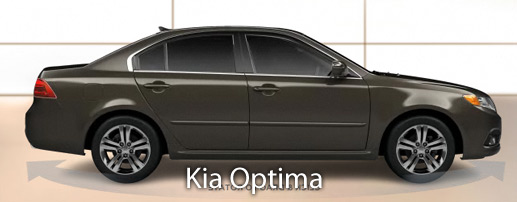
Conclusion
This seemingly inconsequential detail has developed into a key theme of automotive design. It is clear that automotive designers work within a set of guidelines they understand well, knowing how the details impact public perception. This aspect of design is certainly not only relegated to cars, but is carried through other design mediums as well. Web design is no exception. There are features of a site that can be used to instantly exude professionalism and sophistication.
I wanted to take this time to turn it over to the readers and get your thoughts on your favorite subtle design techniques, only noticeable to a very discerning eye, that instantly convey a level of beauty to the site's visitors. What elements come to mind?


Comments
Frank
Thanks you so much, The Hofmeister wrinkle is a little outline highlight of BMWs. It is the name for the little pattern of the back side windows on the C-mainstay of the auto. As opposed to having the back side window expand the distance down as may be normal.Rory B. Saillant
I'll draw your attention to the 1957 Studebaker Golden Hawk which from memory had a similar detail long before BMW.virus
"The Kink" was named the "Hofmeister Kink" as a marketing device by BMW - and that is where the honors for the invention end, in terms of BMW's ownership or creation of the element. The first introduction of the bend dates back to the 1950s on multiple badges including: Lancia, GM, Porsche and Ferrari. I admire your enthusiasm for automotive couture, but the facts here are poorly researched.Jeff Goldster
As others have pointed out the Hofmeister kink was first seen in a 1951 Kaiser Deluxe Golden Dragon as can be seen in this picture:http://www.flickr.com/photos/carphotosbyrichard/7014463073/
As has happened so often before, some people get the credit for the work of others.
Rectfier
No problem, Joel!
BTW it seems Dodge was not the only one. Heres 1958 Toyopet (Toyota) Crown. It also features a wider version of the "kink".
http://www.maltashipphotos.com/productfile.asp?ProductID1=4798&PRODUCTCAT1=Yachts
Rectfier
No problem, Joel.
BTW, heres 1958 Toyopet (Toyota) Crown. It also has a bigger version of the "kink".
http://www.maltashipphotos.com/productfile.asp?ProductID1=4798&PRODUCTCAT1=Yachts
Joel Sutherland NMC team member
Rectifier/Alex,
Thanks for the info. Even if Dodge was early to use it on some models, It certainly seems like BMW owns the idea since they've used it so consistently for so long.
rectifier
@Alex,
Hm, and how about 1960 Dodge Dart Phoenix?
http://www.remarkablecars.com/main/dodge/dodge-00069.html
Alex NMC team member
@Rectifier, you didn't bust any myth. The 1960 Dart does not have anything that resembles the Hofmeister Kink. Niether did it in 1962.
http://www.mywvhome.com/web/cars/cars.htm
This article is correct. Car manufacturers around the world are copying this BMW design. Compare the Australian cars Holden Commodore: 1996, was not there at all. 1997-2006 was there a little bit. 2007+ definitely more pronounced.
Ford Falcon 1997 (not there at all), 1998-2006 there a little bit. Current model: much more pronounced. It's even on the Mazda 3 now! Not every car maker is saving it for premium brands only, but they are all using it to make their cars more "world-class." I'm not the biggest BMW fan, but I know this came from BMW. It is obvious!
Rectifier
Sorry for busting this myth, but first appearance of this "kink" is certainly not in the BMW 1500 from 1961. At least Dodge Dart from 1960 has it.
renato
nice article
Joel Sutherland NMC team member
Chrissie,
Thanks for the notes. I fixed the spelling on Infiniti. As for the FX, I've noticed that SUVs in general don't seem to follow the same pattern.
Chrissie
very interesting article. a couple of corrections:
1. the infiniti 2009 FX does not have the kink
2. infiniti is spelled with an i" at the end, not a "y" as in infinity
thanks for the neat observations."
g
@Bretley: there's no kink in the Honda Fit, doh!
Bretley
@nkw: Your comment that The Kink is included as a style element" on luxury cars is the exact point of this article, no?
Interesting read, thanks!"
nkw
The Kink often appears because the glass has to slide down inside the door. I strongly doubt that the 1961 BMW 1500 was the first BMW to include The Kink. The 1961 BMW 1500's rear side window has 2 panes- the back half of the rear passenger door does NOT roll down. I suspect The Kink was born of necessity in an earlier car, and was included as a style element on the 1961 BMW 1500, even though it was not needed.
The Kink often exists out of necessity on non-luxury cars. For example, my 2007 Honda Fit has a kink in the C pillar:
http://www.bloggingautos.com/wp-content/uploads/2008/08/photos_p_honda_fit_01.jpg"
MattF
The Camry doesn't have the kink - it's a comparison to the upscale Lexus.
Adam Snider
Am I the only one who doesn't see the kink present on the Camry pictured?
jwp
http://tinyurl.com/cztfx2"jwp
the 'kink' is pretty dubious on the 540iT. while it's not a sharp corner, i wouldn't call it a 'kink' http://www.garojrdesign.com/site"Rob O.
Saw a show on Discovery several months ago that examined design cues in the automotive industry and it was just fascinating! They delved into the shape of the dog leg" that is made up of the C-pillar and the adjoining body panel and how subtly altering that shape affects the perceived abilities of the car. The show also talked about how designers could use subtle (and fairly simple) fender and body cues to suggest muscularity or power - even if the car isn't especially powerful.
Dunno exactly why, but that show really stuck in my head and I catch myself examining little often-unnoticed details in automotive design. I've often wondered why more designers working on economy cars don't include at least some of these tricks to make them more appealing beyond consumers who're primarily considering price. It's amazing how much more an extra crease or dimple in the sheet metal can convey..."
Cody Robbins
@nick: The cuff buttonholes of bespoke suits are actually a more apt analogy than you might at first think. Bespoke suits usually didn't have real cuff buttonholes until a few decades ago, just like BMWs were the only cars with Hofmeister kinks. (Vets and doctors were generally the only people with suits made with real buttonholes, so they could roll up their sleeves.) However, at some point, apparently, someone decided to put real buttonholes on as a distinguishing mark to make their suits seem of higher quality. Because, of course, a suit with real cuff buttonholes must be higher quality than a suit with false ones, right? After that, I assume, everyone had to put real buttonholes on their suits to avoid the perception that their suits were cheaper.
What isn't obvious is that a tailored suit is extremely expensive and meant to last for thirty years, and the reason the buttonholes are false is so that the suit can be altered. The sleeve can't be shortened if it has buttonholes in it. Since over the course of thirty years one might be expected to gain or lose weight, or even hand a coat down to their son, it makes sense that the buttonholes aren't real so that it can be altered.
http://www.englishcut.com/archives/000215.htmlJoel Sutherland
@Tom
Great catch! The original image wasn't too much larger than that and I missed that it was a new hardtop convertible.
Tom
Love these notes. But I believe the car labelled as an e90 is in fact the convertible, the e93.
Joel Sutherland
@guruz
Audi has taken a much more unique design direction on their newest models -- none seem to have the kink.
They are owned by VW, the Jetta does not have it, but the higher-end Passat does.
guruz
Interesting overview of it :)
Audi seems to have it too in some models.
nick
The sleeve buttons on bespoke saville row suits actually work; most pret-a-porter suits' sleeve buttons do not have buttonholes. It's a subtle distinction you don't notice until you get a bespoke suit (or read this).
Leave a comment