Loudoun County Department of Economic Development

An Economic Development Website for the Data Center Capital of the World

The Loudoun County Department of Economic Development is the business recruitment and retention arm for one of the most economically significant counties in the United States. Located in Northern Virginia, just outside Washington, D.C., Loudoun County is home to "Data Center Alley," the world's largest concentration of data centers. Much of the world's internet traffic passes through Loudoun's digital infrastructure, and the county's data center industry generates more than $1 billion in annual local tax revenue.

But Loudoun is more than data centers. The county is also home to Dulles International Airport, the Washington Metro Silver Line's westernmost stations, a thriving agribusiness community, a growing small business ecosystem, and a workforce where more than 63% of residents hold a bachelor's degree or higher. As the AI boom intensifies global demand for digital infrastructure, Loudoun finds itself at the center of one of the most important technological developments of our time, and its economic development website needed to reflect that position.

We led the project through a full strategy, information architecture, design and development process, taking the organization from an outdated site that lacked engagement and visual impact to a polished, brand-forward WordPress platform built to serve multiple audiences and tell the story of a county that's simultaneously powering the future and preserving its local character.

Positioning Loudoun for What's Next and Brand-Forward Design

Through our discovery process, we identified several key goals and issues with the existing site. The previous design was clean but generic, with messaging that got lost in carousel formats, links that blended together, and content that didn't adequately convey the benefits of locating in Loudoun. The site lacked interactive elements to engage visitors, and its visual language didn't match the innovation happening in the county itself.

Our goals for the redesign centered on three priorities: draw the attention of site selectors to Loudoun's competitive advantages, tell the success stories of businesses thriving in the county, and provide practical information for prospective business owners. Underneath all of that was a larger ambition to position Loudoun for the future, conveying that this is a county at the forefront of technology, global connectivity, and economic opportunity.

The broader design direction evolved the existing brand palette toward a more refined, professional look while retaining the organization's signature red.  One of our most impactful decisions was to lean heavily into Loudoun's existing brand mark, a multi-pointed star with bold red and orange arrows, and make it a defining element of the site's visual language.

Making the Case to Site Selectors

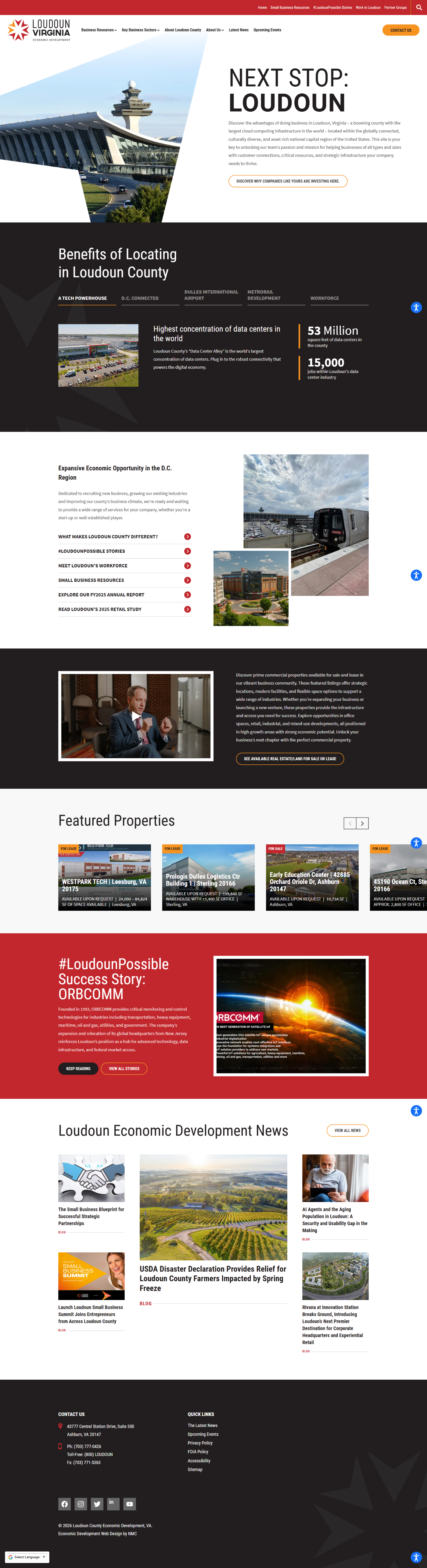
A core goal of the site is to build a compelling, data-backed case for locating in Loudoun, and then make it easy for prospects to take the next step. That narrative starts right on the homepage with a tabbed benefits carousel that organizes Loudoun's competitive advantages into themed sections: A Tech Powerhouse, D.C. Connected, Dulles International Airport, Metrorail Development, and Workforce. Each tab combines an image, narrative description, and large-format statistics, letting a site selector click through and quickly understand the full picture of what the county offers. The carousel is fully CMS-managed, so the Loudoun team can update statistics and swap content as the county's story continues to evolve.

Below the benefits carousel, the homepage surfaces featured commercial properties pulled in through an integration with LoopNet and the county's site selector tools. Each listing includes an image, sale/lease designation, pricing, square footage, and location, with click-through to the full listing on the external platform. The site also highlights featured greenfield sites and the Rivana at Innovation Station development, a major mixed-use project planned around the Silver Line metro stops. Paired with a featured #LoudounPossible success story showcasing a real business thriving in the county, the homepage builds a complete prospect narrative: here's why Loudoun, here's where you'd go, and here's someone who's already done it.

Sub-Brands for Distinct Audiences

One of the most strategically interesting aspects of this project is the sub-brand architecture. Loudoun's economic development efforts span audiences that have very different needs, from site selectors evaluating data center capacity to first-time small business owners looking for mentorship. Rather than forcing all of those audiences through a single navigation, we created a system of semi-autonomous sub-brands that live within the main site but feel like their own destinations.

Each sub-brand, including Launch Loudoun for small business and entrepreneurship, Work in Loudoun for workforce development, #LoudounPossible Stories for business success profiles, and Partner Groups for organizational collaborators, has its own logo, navigation, visual identity, and deep content. Launch Loudoun, for example, organizes its resources around a business lifecycle framework ("I'm Ready to Start," "I'm Ready to Scale," "I'm Ready to Soar") with dedicated programming, event listings, and contact information for the small business team.

The key design challenge was making these sub-brands feel distinctive enough to function independently while never losing the connection to the main Loudoun Economic Development platform. We solved this with a persistent brand bar across the top of every page, including the most independent sub-brands, that provides one-click access back to the main site and to the other sub-brands. The sub-brands each have their own color accents and header treatments, but they share the same underlying WordPress infrastructure, block system, and footer, creating a cohesive ecosystem that's manageable for the Loudoun team to maintain.

We worked hard to give sub-brands real autonomy within a unified platform, which is a consistent request and need we see among clients, like nonprofit website designs, with many different audience groups.

Deep Business Sector Pages

Loudoun's economy is remarkably diverse, spanning everything from data centers and cybersecurity to agribusiness and federal government contracting. The site's navigation makes all of these sectors immediately accessible, and each one has a dedicated landing page that functions as a self-contained content hub.

Each industry can leverage designed blocks and features within the site to tell its own story, pull in related news, and provide direct contact information for the relevant team member.  This vertical content structure gives Loudoun's team the ability to drive targeted traffic to specific sectors, whether through direct outreach at a trade show, email campaigns, or paid advertising, and ensures that visitors researching a particular industry can go as deep as they need without having to hunt for information.


Built on WordPress for Ongoing Growth

The site is built on WordPress with a modular block system that gives the Loudoun team control over all of their content. News posts, event listings, business sector pages, success stories, and property features can all be managed and updated within the CMS. The block-based architecture ensures that new content matches the established design style, and the sub-brand structure is flexible enough to accommodate new initiatives as Loudoun's economic development strategy evolves.

The site also includes an events system with submission capabilities, a document library for downloadable resources, team member profiles, and newsletter signup integration through HubSpot, giving the organization a comprehensive digital hub for both external marketing and stakeholder engagement.

Related Economic Development Website Designs

NMC has deep experience building websites for economic development organizations at every scale. You can see related work in our case studies for the Wake County Economic Development website, the Chapel Hill Economic Development website, and the Downtown Cary Park website, or explore our full economic development web design portfolio.